
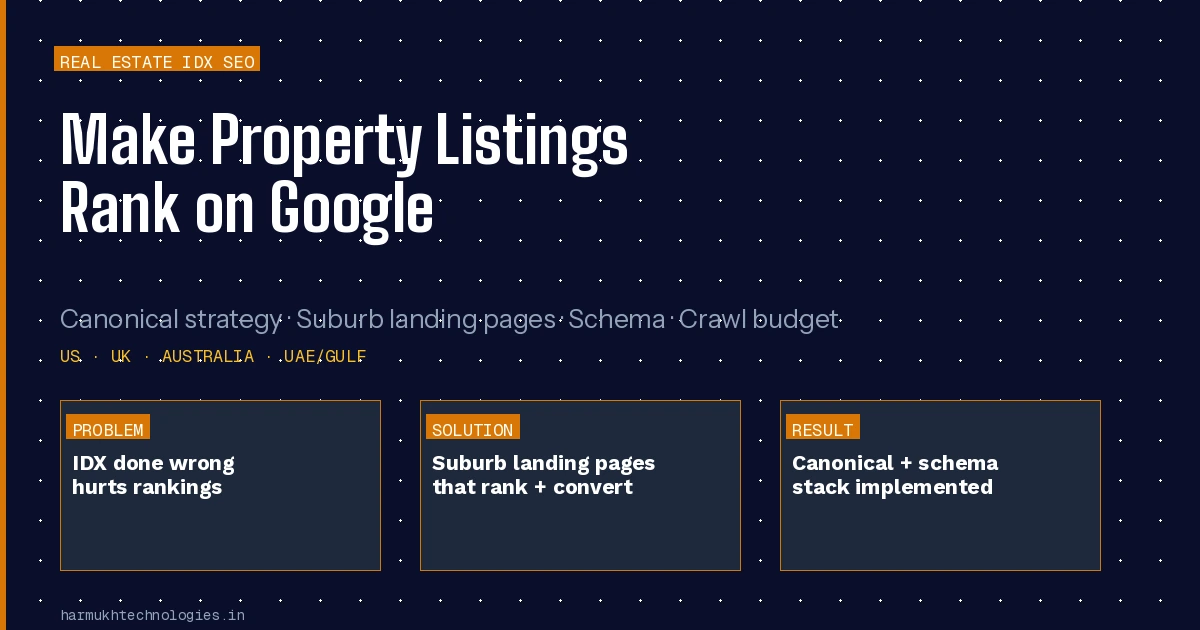
IDX integration — pulling live MLS or portal listings into a real estate website — is one of the most misunderstood SEO decisions an agent or brokerage can make. Done incorrectly, it adds thousands of thin duplicate pages that dilute the site’s topical authority, consume crawl budget on content Google will never rank, and create a technical debt that suppresses the performance of every other page on the domain. Done correctly, it provides a content foundation for suburb-level landing pages that can rank, convert, and build the agent’s authority for the areas they serve.
The difference between IDX that harms SEO and IDX that helps it is not which IDX provider you use — it is how you configure the technical implementation, where you apply canonical tags, which pages you decide to index, and how much original agent-written content you layer on top of the listing data. This guide covers every element of that decision. For the broader strategic context — including neighbourhood page architecture and GBP optimisation — see our full Real Estate SEO guide, and our SEO budget defence guide for the financial framing that justifies technical SEO investment to principals and managing directors.
- The IDX duplicate content trap: why default implementations hurt rankings
- Canonical strategy: which IDX pages to index and which to suppress
- Suburb landing pages: the IDX SEO asset that compounds
- Schema for IDX pages: RealEstateListing implementation
- Crawl budget: protecting the pages that matter
- The IDX content layer: what to write above listings
- IDX SEO audit: the 8-point technical checklist
- Frequently asked questions
The IDX Duplicate Content Trap: Why Default Implementations Hurt Rankings
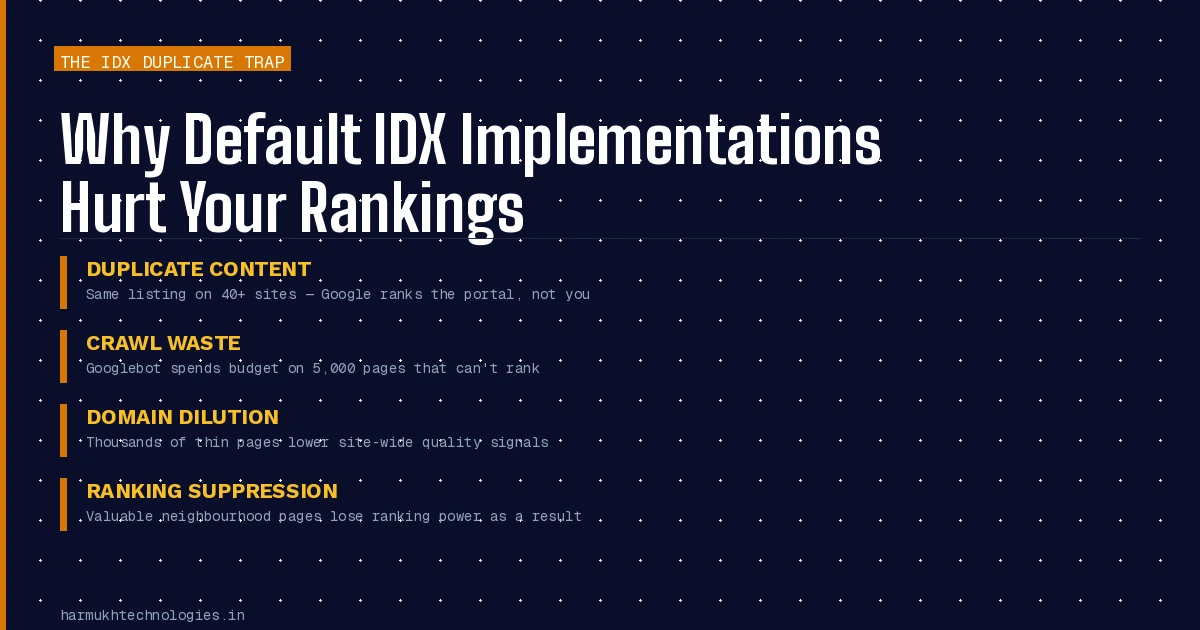
The default IDX implementation — pulling MLS listing data and displaying it on agent website pages with the listing content unchanged — creates a duplicate content problem at scale. A listing that appears on Zillow, Realtor.com, Trulia, and 40 agent websites simultaneously gives Google no reason to rank any individual agent’s version above the authoritative portal source. The portal has higher domain authority, more inbound links, more user engagement data, and a more established crawl history. The agent’s IDX copy of the same listing will not rank — but Google will still crawl it, consuming crawl budget that could be spent on the pages that can rank.
How IDX harms the entire domain
The problem extends beyond the IDX pages themselves. A website with 5,000 thin IDX listing pages that Google has determined are low-value will see its overall crawl budget reduced and its domain-wide quality signals diluted. Google’s quality assessments are partially domain-wide — a site with thousands of thin pages signals lower overall content quality, which can suppress rankings for the genuinely valuable pages (neighbourhood guides, agent service pages, blog content) that the IDX implementation was never supposed to affect. This is the hidden cost of unmanaged IDX implementation that most agents and their web developers never anticipate. Our piece on the SEO audit blind spot covers the cleanup-first principle that applies here before any new content investment.
Canonical Strategy: Which IDX Pages to Index and Which to Suppress
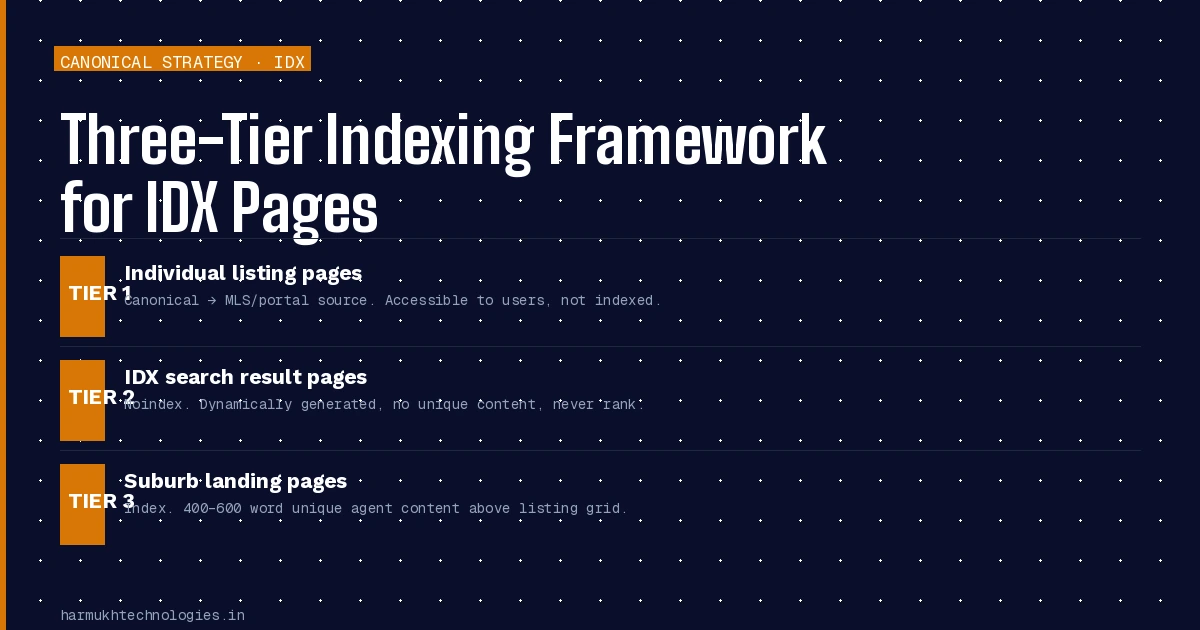
The solution to the IDX duplicate content problem is a three-tier canonical and indexing strategy that distinguishes between IDX pages by their SEO function and potential.
Tier 1: Individual listing pages — canonical to source
Individual listing pages — showing a single property with its MLS data — should carry a canonical tag pointing to the MLS or portal source (Zillow listing URL, Rightmove listing URL). This tells Google that the authoritative version of this content is elsewhere, preventing indexation of the duplicate without removing the page from the agent’s website (where it serves a legitimate user function for buyers browsing current inventory). This is not a noindex — the page remains accessible to users and can be linked to internally. It simply surrenders the page’s indexation potential to the source, which was already ranking for it.
Tier 2: Search result pages — noindex
IDX search result pages — showing filtered lists of listings (e.g., “2 bedroom apartments for sale in Austin”) — should be noindexed unless they have substantial, original, agent-written content above the listing grid. These pages are generated dynamically by the IDX system, have near-zero unique content, and change constantly as listings are added and removed. They are fundamentally incompatible with organic ranking — they exist to serve users who are already on the site, not to attract users from Google. Noindexing them immediately reduces the crawl waste and quality dilution they create.
Tier 3: Suburb landing pages — index with unique content
The exception to the IDX noindex rule is suburb landing pages that have been given genuine SEO investment: a 400–600 word agent-written introduction providing local market insight specific to that suburb, structured with H2/H3 headings, internal links to related neighbourhood content, and schema markup — with IDX listings appearing below as supporting market data rather than as the primary page content. These pages can rank for suburb-level buyer queries and simultaneously serve as the best conversion pages on the site, because the combination of local authority content and live listing inventory is exactly what a buyer researching an area wants. This is covered in depth in the next section.
Suburb Landing Pages: The IDX SEO Asset That Compounds
A properly built suburb landing page is the highest-ROI page type in real estate SEO because it serves three functions simultaneously: it ranks for buyer research queries (“buying in [suburb],” “properties for sale in [suburb]”), it converts buyers who are actively searching for properties in that area, and it builds the agent’s topical authority for that specific location — which improves the ranking performance of every other piece of content about that suburb.
Suburb landing page anatomy
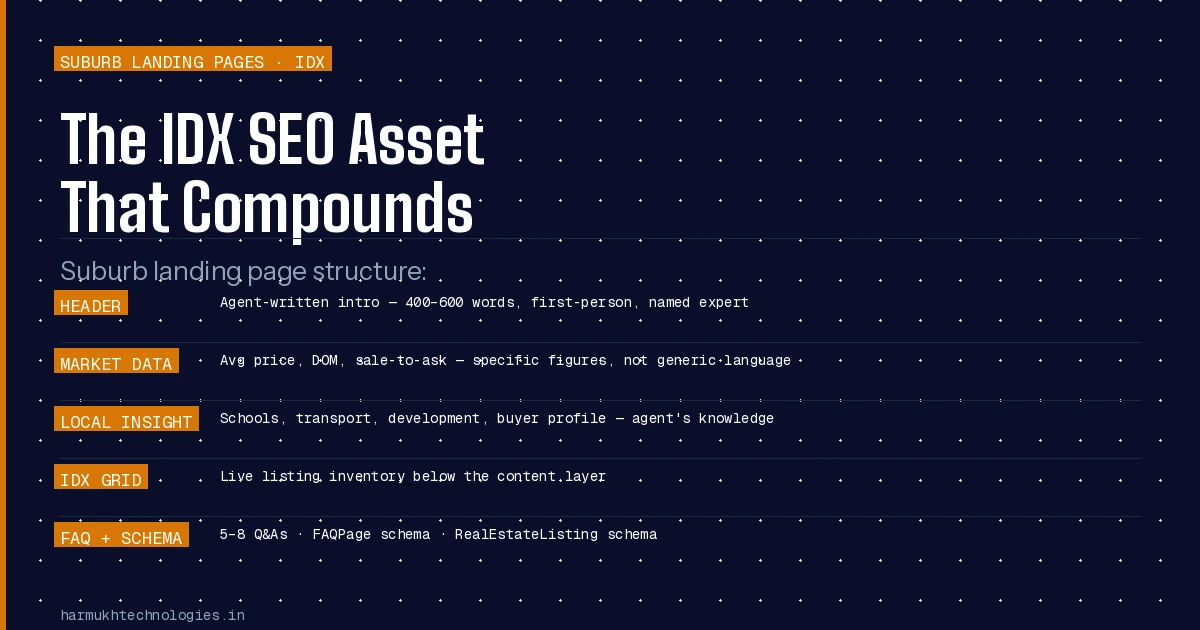
The structure that works: an agent-written header section (400–600 words) with a BLUF opening stating exactly what the page covers and why this agent is the authority, followed by H2 sections covering the local market overview, typical property types and price ranges, what buyers in this area should know, and a brief market snapshot with specific recent data. Below this content block, the IDX listing grid displays current available properties. A FAQ section with FAQPage schema closes the page, covering the 5–8 questions buyers searching this suburb most commonly ask. For on-page optimisation mechanics that apply to every element of this structure, our complete on-page SEO guide covers title tags, heading hierarchy, internal links, and schema in full.
Building suburb pages at scale without producing thin content
The most common failure mode in suburb landing page production is scaling quantity before establishing quality depth. Ten genuinely useful suburb pages — each with specific local data, named agent expertise, and structured FAQ content — will produce better organic results than 50 templated pages where only the suburb name and postcode have been changed. Build the first 5 pages for your most active suburbs to full depth, establish ranking baselines, then expand to additional suburbs using the same framework. Our guide on why content volume without depth fails covers exactly this failure mode and how to avoid it.
Schema for IDX Pages: RealEstateListing Implementation
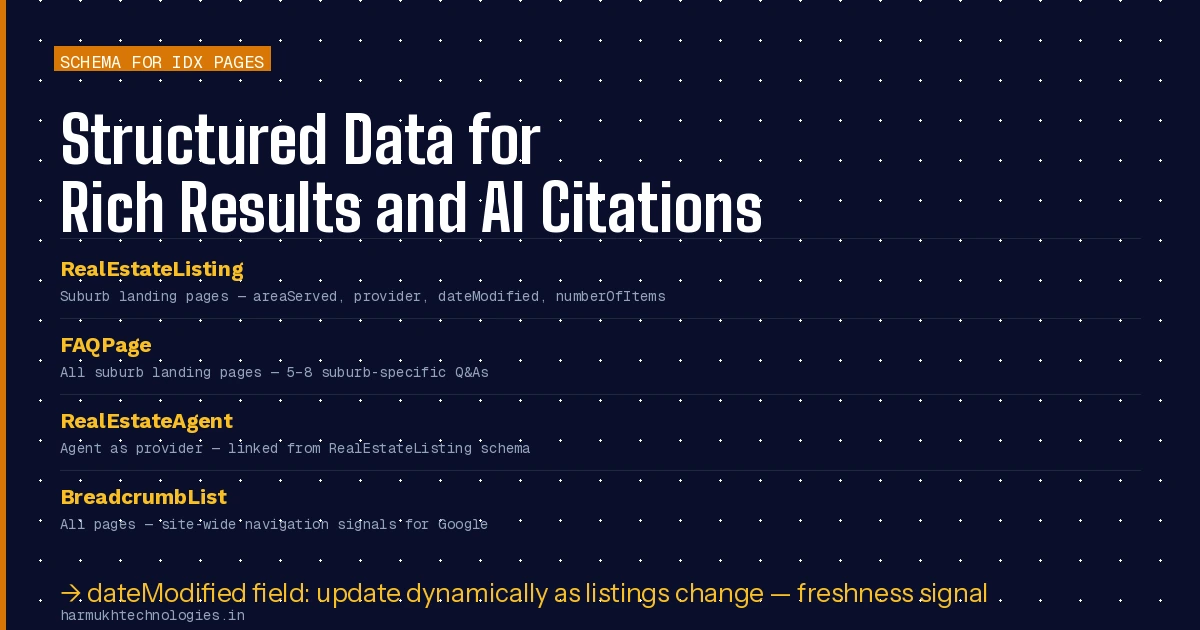
RealEstateListing schema — part of the schema.org vocabulary — allows real estate websites to mark up property listings with structured data that Google can use to generate rich search results. For IDX suburb landing pages where the agent is maintaining a live, managed index of local properties, RealEstateListing schema on the indexed suburb pages (not the individual listing pages, which are canonicalled to source) signals to Google that this is a curated, locally authoritative collection of properties rather than a mass-duplicate feed.
Key RealEstateListing fields for suburb pages
The most important fields for IDX suburb landing pages are: areaServed (specific suburb with geo coordinates), provider (linked to the agent’s RealEstateAgent schema), numberOfItems (current listing count — dynamically updated), dateModified (last update timestamp — critical for freshness signals), and about (linked to the neighbourhood’s administrative area entity). The dateModified field is particularly valuable for IDX pages because the listing content changes daily — a current dateModified timestamp signals to Google that this is a live, maintained resource rather than a static duplicate.
FAQPage schema on suburb landing pages
The FAQ section of every suburb landing page should be marked up with FAQPage schema. The questions should be specific to the suburb: “What is the average house price in [suburb]?”, “How competitive is the [suburb] property market in 2026?”, “What types of properties are available in [suburb]?”, “What should buyers know about [suburb] before making an offer?” Each structured answer is independently citation-eligible for AI answer engines querying for suburb-specific property information — creating a GEO citation layer on top of the organic ranking function. For the complete GEO methodology, our GEO vs SEO guide covers AI citation optimisation for real estate content in detail.

Crawl Budget: Protecting the Pages That Matter
Crawl budget — the number of pages Googlebot will crawl on a domain in a given time period — is finite for all websites, and particularly constrained for real estate websites with large IDX implementations. A website with 10,000 IDX pages, 200 neighbourhood pages, and 50 service pages needs to ensure that Googlebot spends its crawl allocation on the 250 pages that can rank rather than the 10,000 that cannot.
Crawl budget management for IDX sites
The technical interventions that protect crawl budget for IDX sites: implement noindex on all IDX search result pages; add canonical tags on all individual listing pages pointing to source; use robots.txt to disallow crawling of IDX search result page parameters (pagination, filter queries); submit an XML sitemap containing only the pages you want indexed (suburb landing pages, neighbourhood guides, agent profile pages, service pages) — and explicitly exclude all IDX pages from the sitemap. Monitor crawl activity in Google Search Console’s Crawl Stats report monthly. A well-managed IDX implementation will show Googlebot spending 80%+ of its crawl allocation on the content pages, not the listing database.
The IDX Content Layer: What to Write Above Listings
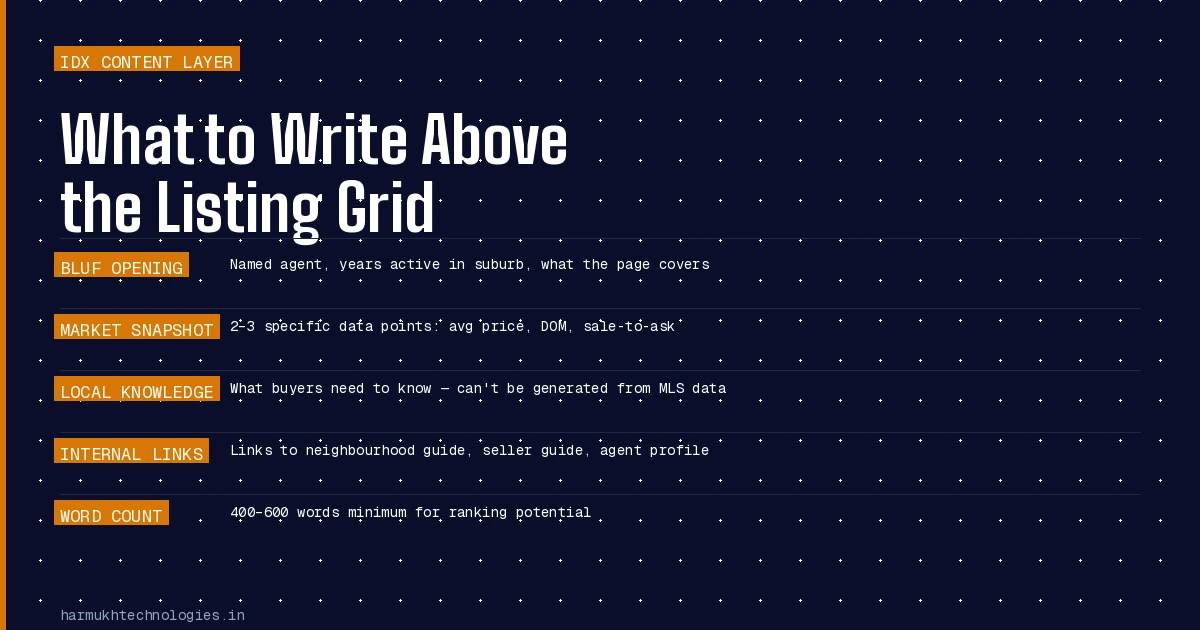
The content layer above the IDX listing grid is the single most important SEO element on a suburb landing page — it is what differentiates an indexed suburb page from a noindexed search result page, and it is what makes the page citation-eligible for AI answer engines. It must be original, specific, locally authoritative, and written by or attributed to the agent whose expertise makes it credible.
The BLUF content structure for suburb landing pages
Opening paragraph (BLUF): State exactly what the page covers and why this agent is the authority. “As an agent with 12 years of transactions in [suburb], I’ve put together this guide to the current [suburb] property market — including what’s selling, what buyers are paying, and what you need to know before making an offer in this area.” This signals to both Google and AI citation systems that the content has a named expert source with specific local experience.
Market snapshot: Current average price by property type, current days-on-market, comparison with 12 months prior. Even two or three specific data points make the content citation-eligible — generic language without numbers is not citeable. If you’re wondering how to approach content production across multiple suburbs systematically, our real estate content strategy guide covers the full production framework. And our AI SEO tools guide for 2026 covers the tools that accelerate research and data aggregation without compromising content quality.
IDX SEO Audit: The 8-Point Technical Checklist
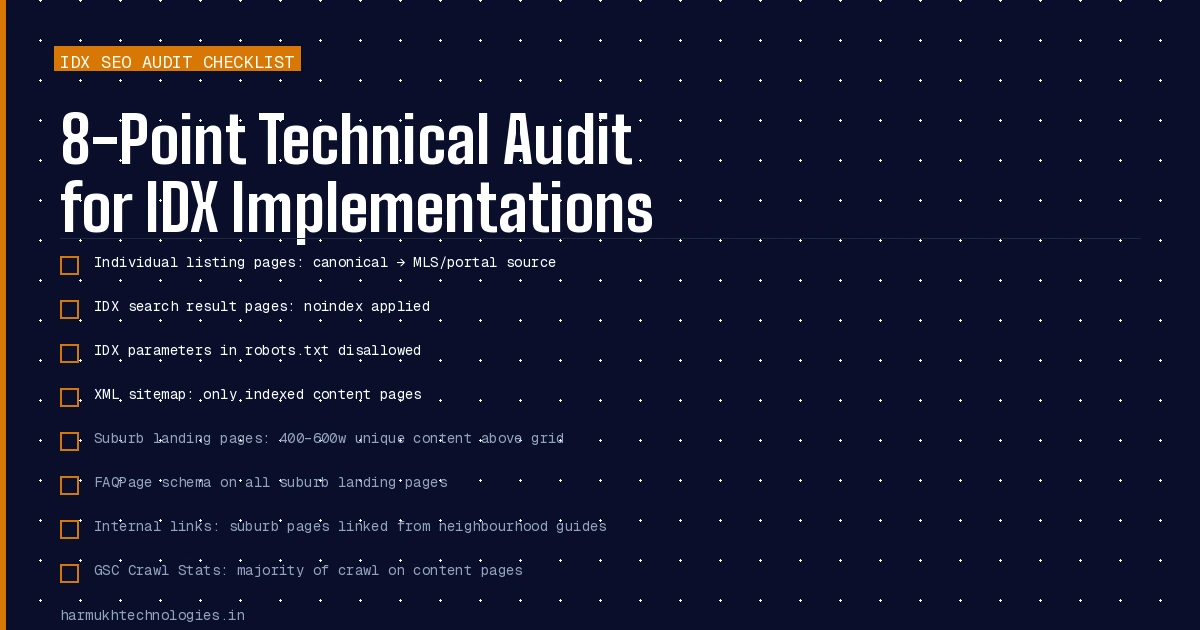
- Individual listing pages: canonical tag pointing to MLS/portal source
- IDX search result pages: noindex meta tag applied
- IDX parameters in robots.txt: filter/sort/pagination params disallowed
- XML sitemap: contains only indexed pages — no IDX listing or search pages
- Suburb landing pages: 400–600 words unique agent content above listings
- Schema: FAQPage on all suburb landing pages; RealEstateListing where applicable
- Internal links: suburb landing pages linked from neighbourhood guides and homepage
- GSC Crawl Stats: Googlebot spending majority of crawl on content pages, not IDX
Running this audit on an existing IDX implementation typically identifies 3–5 technical changes that can be implemented within a week and will produce measurable crawl budget improvement within 30 days — with ranking improvements for suburb content pages following within 60–90 days. Our 90-day SEO plan provides the full sequenced programme for implementing technical fixes alongside content development for maximum compounding effect. For context on how IDX SEO fits within the broader evolution of real estate search, our 7 SEO trends for 2026 covers what’s changing and what isn’t.
Frequently Asked Questions About IDX SEO
Should I noindex all IDX pages?
Does IDX SEO work differently in the UK and Australia (no MLS)?
How much unique content does a suburb landing page need to be indexed?
View our SEO consulting services ·
Schedule an IDX SEO audit ·
View SEO pricing